
Журнал «Здоровье ребенка» Том 20, №7, 2025
Вернуться к номеру
Роль анестезіолога в організації та наданні спеціалізованої паліативної допомоги дітям
Авторы: Снісарь В.І. (1), Кравець О.В. (1), Власов О.О. (2), Площенко Ю.О. (1), Єгоров С.В. (2)
(1) - Дніпровський державний медичний університет, м. Дніпро, Україна
(2) - КНТ «Регіональний медичний центр родинного здоров’я» ДОР, м. Дніпро, Україна
Рубрики: Педиатрия/Неонатология
Разделы: Справочник специалиста
Версия для печати
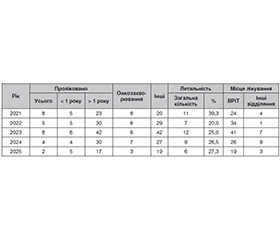
Актуальність. У цій статті ми розглянули роль дитячого анестезіолога в організації та наданні паліативної допомоги дітям та їхнім сім’ям у межах його професійної компетенції. У багатьох випадках звичайна паліативна допомога містить методи інтенсивної терапії навіть тоді, коли дитина перебуває вдома. Це виходить за рамки компетентності лікаря первинної медико-санітарної допомоги, і тоді для оптимізації комплексного підходу необхідна консультативна, а може, й безпосередня допомога лікаря-анестезіолога. Матеріали та методи. Наші спостереження ґрунтуються на аналізі організації паліативної допомоги дітям у КНТ «Регіональний медичний центр родинного здоров’я», бригади якого консультують медичних працівників, які надають лікарські послуги паліативним дітям та їхнім батькам. Відвідування мобільної бригади паліативної допомоги є дуже важливим. Результати. За рік відбулося 716 виїздів, з яких у 21 % випадків бере участь анестезіолог. Це потрібно тоді, коли необхідна організація додаткових складних технологій догляду або рішення про необхідність госпіталізації дитини до стаціонару або відділення інтенсивної терапії. Спеціалізовану паліативну допомогу вдома було надано 24 дітям. Виїзд анестезіолога здебільшого був плановим, але у 35 % випадків виклик бригади був через розвиток кризових подій чи надзвичайних ситуацій із дитиною. Одинадцять дітей було направлено до стаціонару у відділення інтенсивної терапії для забезпечення екстреної допомоги. До трьох дітей, яким вдома проводиться штучна вентиляція легень, лікар-анестезіолог виїжджає планово щонайменше 2 рази на тиждень, а за необхідності і частіше. Висновки. Співпраця лікарів первинної ланки та анестезіологів, що спеціалізуються на паліативній допомозі, має величезний потенціал для взаємної вигоди. Участь анестезіолога в паліативній допомозі дітям забезпечує інтегративну, цілісну форму догляду за медично складними дітьми та їхніми сім’ями.
Background. In this article, we examined the role of a pediatric anesthesiologist in the organization and provision of palliative care for children and their families, which is within his competence. In many cases, ordinary palliative care includes intensive care methods, even when the child is at home. This goes beyond the competence of a primary care physician and then, to optimize the comprehensive approach, consultative, and perhaps direct assistance from an anesthesiologist is necessary. Materials and methods. Our observations are based on an analysis of the organization of palliative care for children in the Dnipro Regional Medical Center of Family Health, whose teams consult medical workers who provide palliative care for children and their parents. Visits by a mobile palliative care team are very important. Results. There were 716 visits per year, of which an anesthesiologist participated in 21 % of cases. This is required when it is necessary to organize additional, more complex care technologies or decide on the need to hospitalize a child to an inpatient facility or intensive care unit. Specialized palliative care at home was provided to 24 children. Anesthesiologist’s visit was mostly planned, but in 35 % of cases, the team was called due to the development of crisis events or emergencies with the child. Eleven children were admitted to the intensive care unit to provide emergency care. An anesthesiologist makes scheduled visits, at least twice a week, to the three children who are ventilated at home, and more often if necessary. Conclusions. Collaboration between primary care physicians and anesthesiologists specializing in palliative care has enormous potential for mutual benefit. In essence, the anesthesiologist’s involvement in palliative care for children provides an integrative, holistic form of care for medically complex children and their families.
діти; паліативна допомога; інтенсивна терапія
children; palliative care; intensive care
Для ознакомления с полным содержанием статьи необходимо оформить подписку на журнал.
- Feudtner C, et al. Appendix F: pediatric end-of-life and palliative care: epidemiology and health service use/Dying in America: Improving quality and honoring individual preferences near the end of life. National Academies Press; 2015. Available from: http://dx.doi.org/10.17226/18748.
- Наказ Міністерства охорони здоров’я від 04.06.2020 р. № 1308 «Про удосконалення організації надання паліативної допомоги в Україні». https://zakon.rada.gov.ua/laws/show/z0609-20#Text.
- Наказ Міністерства охорони здоров’я від 04.10.2024 р. № 1853 «Про затвердження змін до Порядку надання паліативної допомоги». https://zakon.rada.gov.ua/laws/show/z1746-24#Text.
- Marston J, Boucher S, Downing J. International Children’s Palliative Care Network: A Global Action Network for Children With Life-Li–miting Conditions. Journal of Pain and Symptom Management [Internet]. 2018 Feb;55(2):S104-11. Available from: http://dx.doi.org/10.1016/j.jpainsymman.2017.03.024.
- Knapp J, Mulligan-Smith D. Death of a Child in the Emergency Department. Pediatrics [Internet]. 2005 May 1;115(5):1432-7. Available from: http://dx.doi.org/10.1542/peds.2005-0317.
- Meert KL, Keele L, Morrison W, Berg RA, Dalton H, Newth CJL,
- et al. End-of-Life Practices Among Tertiary Care PICUs in the United States. Pediatric Critical Care Medicine [Internet]. 2015 Sep;16(7):e231-8. Available from: http://dx.doi.org/10.1097/pcc.0000000000000520.
- Trowbridge A, Walter JK, McConathey E, Morrison W, Feudtner C. Modes of Death Within a Children’s Hospital. Pediatrics [Internet]. 2018 Oct 1;142(4). Available from: http://dx.doi.org/10.1542/peds.2017-4182.
- DeCourcey DD, Silverman M, Oladunjoye A, Balkin EM, Wolfe J. Patterns of Care at the End of Life for Children and Young Adults with Life-Threatening Complex Chronic Conditions. The Journal of Pediatrics [Internet]. 2018 Feb;193:196-203.e2. Available from: http://dx.doi.org/10.1016/j.jpeds.2017.09.078.
- Keele L, Keenan HT, Sheetz J, Bratton SL. Differences in Cha–racteristics of Dying Children Who Receive and Do Not Receive Palliative Care. Pediatrics [Internet]. 2013 Jul 1;132(1):72-8. Available from: http://dx.doi.org/10.1542/peds.2013-0470.
- Lykke C, Ekholm O, Olsen M, Sjøgren P. Paediatric end-of-life care — symptoms and problems: parent assessment. BMJ Supportive Palliative Care [Internet]. 2021 Mar 11;13(e2):e327-33. Available from: http://dx.doi.org/10.1136/bmjspcare-2021-002891.
- Wolff SL, Christiansen CF, Johnsen SP, Schroeder H, Darlington AS, Jespersen BA, et al. Inequality in place-of-death among children: a Danish nationwide study. European Journal of Pediatrics [Internet]. 2021 Sep 4;181(2):609-17. Available from: http://dx.doi.org/10.1007/s00431-021-04250-5.
- Short SR, Thienprayoon R. Pediatric palliative care in the intensive care unit and questions of quality: a review of the determinants and mechanisms of high-quality palliative care in the pediatric intensive care unit (PICU). Translational Pediatrics [Internet]. 2018 Oct;7(4):326-43. Available from: http://dx.doi.org/10.21037/tp.2018.09.11.
- Davis S, Nunn M. Palliative Communication in the Pediatric Intensive Care Unit. Critical Care Nursing Clinics of North America [Internet]. 2023 Sep;35(3):287-94. Available from: http://dx.doi.org/10.1016/j.cnc.2023.04.003.
- Buang SNH, Loh SW, Mok YH, Lee JH, Chan YH. Palliative and Critical Care: Their Convergence in the Pediatric Intensive Care Unit. Frontiers in Pediatrics [Internet]. 2022 Jun 10;10. Available from: http://dx.doi.org/10.3389/fped.2022.907268.
- Moynihan K, Kaye E, Bailey V, Wolfe J, Thiagarajan R, Snaman J. 417: Palliative Care Integration In Pediatric Cardiac Intensive Care Units: A Novel Champion-Based Model. Critical Care Medicine [Internet]. 2019 Jan;47(1):189. Available from: http://dx.doi.org/10.1097/01.ccm.0000551170.37983.db.
- Update on the palliative care approach at the pediatric intensive care unit. Archivos Argentinos de Pediatria [Internet]. 2022 Dec 1;120(6). Available from: http://dx.doi.org/10.5546/aap.2022.eng.e255.
- Prentice TM, Gillam L, Davis PG, Janvier A. The use and misuse of moral distress in neonatology. Seminars in Fetal and Neonatal Medicine [Internet]. 2018 Feb;23(1):39-43. Available from: http://dx.doi.org/10.1016/j.siny.2017.09.007.
- Crain N, Miller J. Palliative Care in the Pediatric Intensive Care Unit. AACN Advanced Critical Care [Internet]. 2024 Jun 15;35(2):134-45. Available from: http://dx.doi.org/10.4037/aacnacc2024104.
- Nelson JE, Bassett R, Boss RD, Brasel KJ, Campbell ML, Cortez TB, et al. Models for structuring a clinical initiative to enhance palliative care in the intensive care unit: A report from the IPAL-ICU Project (Improving Palliative Care in the ICU). Critical Care Medicine [Internet]. 2010 Sep;38(9):1765-72. Available from: http://dx.doi.org/10.1097/ccm.0b013e3181e8ad23.
- Porter AS, Gouda SR, Broden EG, Snaman JM. “Palliative Intensive Care” at the End of a Child’s Life. Hospital Pediatrics [Internet]. 2023 Nov 3;13(12):e395-8. Available from: http://dx.doi.org/10.1542/hpeds.2023-007348.
- Nicoll J, Dryden-Palmer K, Frndova H, Gottesman R, Gray M, Hunt EA, et al. Death and Dying in Hospitalized Pediatric Patients: A Prospective Multicenter, Multinational Study. Journal of Palliative Medicine [Internet]. 2022 Feb 1;25(2):227-33. Available from: http://dx.doi.org/10.1089/jpm.2021.0205.
- Boyden JY, Hill DL, LaRagione G, Wolfe J, Feudtner C. Home-Based Care for Children with Serious Illness: Ecological Framework and Research Implications. Children [Internet]. 2022 Jul 26;9(8):1115. Avai–lable from: http://dx.doi.org/10.3390/children9081115.