
Журнал «Здоровье ребенка» Том 20, №7, 2025
Вернуться к номеру
Вплив природних радіоактивних матеріалів у снеках на здоров’я дітей в Іраку
Авторы: Awsam Abdulsattar Marzaali (1), Ali Abid Abojassim (2)
(1) - Ministry of Education, General Directorate for Thi-Qar Education, Thi-Qar, Iraq
(2) - Department of Physics, Faculty of Science, University of Kufa, Al-Najaf, Iraq
Рубрики: Педиатрия/Неонатология
Разделы: Клинические исследования
Версия для печати
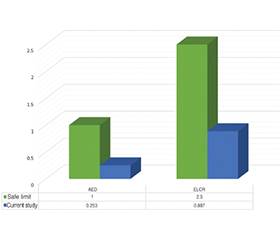
Харчові продукти містять різну кількість природних радіоактивних матеріалів, і ці відмінності пояснюються такими факторами, як клімат, методи ведення сільського господарства й рівень фонової радіації. Визнано, що радіонукліди є основними причинами внутрішнього опромінення людей. Серед природних радіонуклідів найбільш значущими з точки зору радіаційного захисту є ізотопи рядів 238U, 232Th та 40K. Рівень природної радіоактивності в снеках, що споживають діти молодшого шкільного віку (6–12 років), вимірювали за допомогою детектора гамма-спектроскопії NaI(Tl). Діапазон активності на одиницю маси (питома активність) 238U, 232Th та 40K становив відповідно 12,32–28,41, 1–17,4 і 375,16–686,8 Бк/кг. Згідно з даними НКДАР ООН та МКРЗ, надмірний ризик раку протягом життя й показники ефективної річної дози були нижчими за допустимі рівні в більшості досліджуваних зразків.
Food products contained varying amounts of naturally occurring radioactive materials (NORM), and these differences were ascribed to such as climate, farming techniques, and background radiation levels. It is acknowledged that these radionuclides are the primary reasons why people are exposed to radiation internally. Of the radionuclides found in nature, the ones from the decay series of 238U, 232Th, and 40K are the ones that should be protected against radiation the most. The levels of natural radioactivity in snack foods consumed by primary school-age (6–12 years) children is measured with a detector for NaI(Tl) gamma-ray spectroscopy. The range values of activity per unit mass (specific activity) of 238U, 232Th, and 40K were 12.32 to 28.41, 1 to 17.4, and 375.16 to 686.8 Bq/kg, respectively. According to UNSCEAR and ICRP, the excess lifetime cancer risk and total annual effective dose rate were below acceptable levels in the majority of the samples under study.
радіонукліди; харчові продукти; ефективна доза; ризик раку
radionuclides; foodstuff; effective dose; cancer risk
Для ознакомления с полным содержанием статьи необходимо оформить подписку на журнал.
- L’Annunziata MF, ed. Handbook of radioactivity analysis. Academic Press; 2012.
- Vosniakos FK. Radioactivity transfer in environment and food. Springer Science & Business Media; 2012.
- Shukla LI, Bareh AJ, Ashraf A, Goswami R, Vardhan PV. Food irradiation. In: Future Crops and Processing Technologies for Sustainabi–lity and Nutritional Security. CRC Press; 2025. 146-173.
- Poschl M, Nollet LM, eds. Radionuclide concentrations in food and the environment. CRC Press; 2006.
- Abojassim AA, Dosh RJ, Abdulzahar AK. Radioactivity in soil. Curr Res Soil Sci. 2022;89:150-166.
- Abojassim AA, Hashim RH, Mahdi NS. Basics of nuclear radiation. 2021.
- Salih NF. Determination of natural radioactivity and radiological hazards of 226Ra, 232Th, and 40K in the grains available at Penang markets, Malaysia, using high-purity germanium detector. ARO-The Scientific Journal of Koya University. 2018;6:71-77.
- Dosh RJ, Kadhim SH, Abojassim AA, Hussein FAY. Natural radioactivity in Turkish foodstuff consumed in Iraq. J Radiat Res Appl Sci. 2024;17(1):100832.
- Mohammed ZB, Obai IS, Jaafar NA, Abojassim AA, Al-Khayfawee AAG. Natural radioactivity in some local food samples consumed by children in Iraq. Curr Res Nutr Food Sci J. 2024;12(2):856-863.
- Okedeyi SA, Ikuemonisan FE, Olajuwon OO, Atilade AO, Mustapha AO, et al. Assessment of natural radioactivity levels of 40K, 226Ra and 232Th in some selected baby food in southwestern Nigeria. Caliphate J Sci Technol. 2024;6(2):175-183.
- Abojassim AA, Jafer NA, Azeez AJ, Abdulzahra AH, Jebur LY, et al. Radiation dangers in Iranian ceramic samples in local markets. E3S Web Conf. 2024;583:04016.
- Joel ES, Maxwell O, Adewoyin OO, Ehi-Eromosele CO, Embong Z, Oyawoye F. Assessment of natural radioactivity in various commercial tiles used for building purposes in Nigeria. MethodsX. 2018;5:8-19.
- Measurement of radionuclides in food and the environment. Technical Reports Series No. 295. IAEA; 1989.
- Eckerman K, Harrison J, Menzel HG, Clement CH. ICRP publication 119: compendium of dose coefficients based on ICRP publication 60. Ann ICRP. 2012;41:1-130.
- Hamzah ZS, Hashim AK, Abojassim AA. Natural gamma emitters in grains samples of Kerbala governorate markets. AIP Conf Proc. 2022;2547(1).
- ICRP. Age-dependent doses to members of the public from intake of radionuclides. Part 5: compilation of ingestion and inhalation dose coefficients (ICRP publication 72). Phys Med Biol. 1996;41:2807.
- UNSCEAR. Epidemiological evaluation of radiation-induced cancer. UN Scientific Committee on the Effects of Atomic Radiation; 2000a.