
Журнал «Здоровье ребенка» Том 20, №7, 2025
Вернуться к номеру
Функціональні гастроінтестинальні розлади у дітей раннього віку: чому важливі раннє втручання і мультидисциплінарний підхід
Авторы: Личковська О.Л. (1), Семен М.О. (1), Кулачковська І.Ю. (1), Семен В.Д. (2)
(1) - ДНП «Львівський національний медичний університет імені Данила Галицького», м. Львів, Україна
(2) - КНП ЛОР «Клінічний центр дитячої медицини», м. Львів, Україна
Рубрики: Педиатрия/Неонатология
Разделы: Клинические исследования
Версия для печати
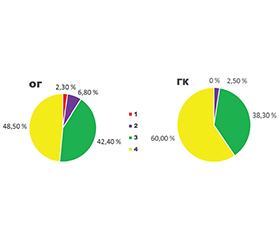
Актуальність. Згідно з біопсихосоціальною моделлю формування функціональних гастроінтестинальних розладів (ФГІР), окрему групу факторів ризику становлять чинники, що діють у ранньому дитинстві. Серед них фігурує стрес немовляти, спричинений поведінкою батьків. Як відомо, найбільш ранніми ознаками раннього стресу є розлади регуляції та функціональні гастроінтестинальні розлади немовлят. Метою дослідження було вивчення зв’язку ранніх проявів стресу немовлят, а саме розладів регуляції та ФГІР дітей раннього віку, з формуванням ФГІР у старших дітей. Матеріали та методи. Дослідження охопило 132 дитини з ФГІР (основна група — ОГ), з них 68 дітей зі синдромом подразненого кишечника (ОГ1) і 64 дитини з функціональною диспепсією (ОГ2). Групу контролю (ГК) становили 60 практично здорових дітей. Проведено поглиблений збір анамнезу за методикою Family history щодо першого року життя дитини. Прояви раннього стресу оцінювали за наявністю ознак розладів регуляції немовлят і ФГІР дітей раннього віку за принципом «є/немає». Результати. В анамнезі дітей з ОГ усі розлади регуляції та ФГІР на першому році життя виявляли частіше, ніж у ГК. Вірогідної різниці частоти ФГІР і розладів регуляції немовлят між ОГ1 та ОГ2 не було. В анамнезі дітей ОГ кольку немовлят констатовано в 39 (29,5 %) випадках, у 7 з них (5,3 %) вона утримувалася понад 3 місяці; зригування — у 42 (31,8 %), у 8 (6,1 %) з них це привело до втрати ваги; у 31 (25,3 %) дитини — розлади випорожнень (переважно схильність до запорів). Розлади сну спостерігалися в анамнезі в 30 (22,7 %) дітей з ОГ; надмірна збудливість, тривалий плач, гіперестезія — у 31 (23,5 %) дитини з ФГІР. Домінували 1–2 розлади в ОГ і ГК, 3–4 розлади виявили в анамнезі у 12 дітей з ОГ і лише в однієї дитини з ГК. Свій емоційний стан протягом першого року життя дитини більшість матерів з ОГ (81 — 61,4 %) описували як тривожний, скаржилися на стійке відчуття втоми, невпевненості в собі та власній спроможності добре доглядати за дитиною. Висновки. Розлади регуляції і ФГІР дітей раннього віку є чинником ризику формування ФГІР у старших дітей. Не виявлено зв’язку окремих варіантів розладів регуляції та ФГІР дітей раннього віку з певними функціональними розладами в старших дітей. Раннє втручання, що передбачає мультидисциплінарний підхід до ведення немовляти з ознаками стресу, може послабити або навіть нівелювати цей вагомий чинник ризику формування ФГІР у старших дітей.
Background. According to the biopsychosocial model of functional gastrointestinal disorders (FGIDs), early childhood factors play an important role, particularly infant stress influenced by parental behavior. The earliest manifestations of such stress are newborn regulatory disturbances and FGIDs in infancy. The purpose was to investigate the relationship between early manifestations of infant stress, namely regulation disorders and FGIDs in young children, and the formation of FGIDs in older children. Materials and methods. A total of 132 children with FGIDs (study group, SG) were examined, including 68 with irritable bowel syndrome (SG1) and 64 with functional dyspepsia (SG2). The control group (CG) consisted of 60 healthy children. A detailed history (family history method) of the first year of life was taken, with an assessment of early stress markers (regulatory disturbances and infant FGIDs) on a yes/no basis. Results. Children in the SG had a significantly higher prevalence of early regulatory disturbances and FGIDs compared with the CG. No significant differences were found between SG1 and SG2. Following symptoms were reported during infancy in the SG: infantile colic — in 39 cases (29.5 %), which persisted beyond 3 months in 7 (5.3 %) of them; regurgitation — in 42 (31.8 %), of which in 8 (6.1 %) led to weight loss; bowel movements disturbances — in 31 (25.3 %) (mostly constipations); sleep disturbances — in 30 (22.7 %) cases; excessive excitability, prolonged crying, or hyperesthesia — in 31 (23.5 %). Combination of one to two disturbances were most common in both SG and CG, whereas 3–4 disturbances were observed in 12 children in the SG and only one in the CG. Most mothers of SG children (81; 61.4 %) described their emotional state during the child’s first year of life as anxious, with persistent fatigue and a lack of confidence in their caregiving abilities. Conclusions. Infant regulatory disturbances represent a significant risk factor for FGIDs in later childhood. No associations were identified between particular types of early regulatory disturbances and specific FGIDs in older children. Early intervention, involving a multidisciplinary approach to the management of an infant with stress symptoms, may reduce or even eliminate this significant risk factor for later FGID development in older children.
діти; функціональні гастроінтестинальні розлади; стрес; фактори ризику
children; functional gastrointestinal disorders; stress; risk factors
Для ознакомления с полным содержанием статьи необходимо оформить подписку на журнал.
- Drossman DA. Functional gastrointestinal disorders: history, pathophysiology, clinical features and Rome IV. Gastroenterology. 2016:S0016-5085(16)00223-7. doi: 10.1053/j.gastro.2016.02.032.
- Kuenzel E, Al-Saoud S, Fang M, Duerden EG. Early childhood stress and amygdala structure in children and adolescents with neurodevelopmental disorders. Brain Struct Funct. 2025;230(1):29. doi: 10.1007/s00429-025-02890-z.
- Hanson JL, Nacewicz BM. Amygdala allostasis and early life adversity: considering excitotoxicity and inescapability in the sequelae of stress. Front Hum Neurosci. 2021;15:624705. doi: 10.3389/fnhum.2021.624705.
- Fogelman N, Canli T. Early life stress, physiology, and genetics: a review. Front Psychol. 2019;10:1668. doi: 10.3389/fpsyg.2019.01668.
- Gee DG. Caregiving influences on emotional learning and regulation: Applying a sensitive period model. Curr Opin Behav Sci. 2020 Dec;36:177-184. doi: 10.1016/j.cobeha.2020.11.003.
- Tottenham N. Neural meaning making, prediction, and prefrontal-subcortical development following early adverse caregiving. Dev Psychopathol. 2020;32(5):1563-1578. doi: 10.1017/S0954579420001169.
- Koss KJ, Gunnar MR. Annual research review: early adversity, the hypothalamic-pituitary-adrenocortical axis, and child psychopathology. J Child Psychol Psychiatry. 2018;59(4):327-346. doi: 10.1111/jcpp.12784.
- Jones-Mason K, Coccia M, Alkon A, Melanie Thomas KC, La–raia B, Adler N, et al. Parental sensitivity modifies the associations between maternal prenatal stress exposure, autonomic nervous system functioning and infant temperament in a diverse, low-income sample. Attach Hum Dev. 2023;25(5):487-523. doi: 10.1080/14616734.2023.2257669.
- Beurel E, Nemeroff CB. Early life adversity, microbiome, and inflammatory responses. Biomolecules. 2024;14(7):802. doi: 10.3390/biom14070802.
- Zhou GQ, Huang MJ, Yu X, Zhang NN, Tao S, Zhang M. Early life adverse exposures in irritable bowel syndrome: new insights and opportunities. Front Pediatr. 2023;11:1241801. doi: 10.3389/fped.2023.1241801.
- Sjölund J, Uusijärvi A, Tornkvist NT, Kull I, Bergström A, Alm J, et al. Prevalence and progression of recurrent abdominal pain, from early childhood to adolescence. Clin Gastroenterol Hepatol. 2021;19(5):930-938.e8. doi: 10.1016/j.cgh.2020.04.047.
- Fu Y, Thomas R, Cares K. Influence of family history on children with irritable bowel syndrome. Journal of Pediatric Gastroenterology and Nutrition. 2021;72(6):866-9. doi: 10.1097/mpg.0000000000003059.
- Kahhalé I, Barry KR, Hanson JL. Positive parenting moderates associations between childhood stress and corticolimbic structure. PNAS Nexus. 2023 Jun 13;2(6):pgad145. doi: 10.1093/pnasnexus/pgad145.
- Xu J, Guan X, Li H, Zhang M, Xu X. The Effect of Early Life Stress on Memory is Mediated by Anterior Hippocampal Network. Neuroscience. 2020;451:137-148. doi: 10.1016/j.neuroscience.2020.10.018.
- Russell JD, Heyn SA, Peverill M, DiMaio S, Herringa RJ. Traumatic and Adverse Childhood Experiences and Developmental Differences in Psychiatric Risk. JAMA Psychiatry. 2025;82(1):66-74. doi: 10.1001/jamapsychiatry.2024.3231.
- Chocyk A, Majcher-Maślanka I, Dudys D, Przyborowska A, Wędzony K. Impact of early-life stress on the medial prefrontal cortex functions — a search for the pathomechanisms of anxiety and mood disorders. Pharmacol Rep. 2013;65(6):1462-70. doi: 10.1016/s1734-1140(13)71506-8.
- Deng S, Xie R, Kong A, Luo Y, Li J, Chen M, et al. Early-life stress contributes to depression-like behaviors in a two-hit mouse model. Behav Brain Res. 2023;452:114563. doi: 10.1016/j.bbr.2023.114563.
- Lawrence S, Scofield RH. Post traumatic stress disorder associated hypothalamic-pituitary-adrenal axis dysregulation and physical illness. Brain Behav Immun Health. 2024;41:100849. doi: 10.1016/j.bbih.2024.100849.
- Juruena MF, Eror F, Cleare AJ, Young AH. The role of early life stress in HPA axis and anxiety. Adv Exp Med Biol. 2020;1191:141-153. doi: 10.1007/978-981-32-9705-0_9.
- Qu S, Yu Z, Zhou Y, Wang S, Jia M, Chen T, Zhang X. Gut microbiota modulates neurotransmitter and gut-brain signaling. Microbiol Res. 2024;287:127858. doi: 10.1016/j.micres.2024.127858.
- Zhang Z, Hu Y, Lv G, Wang J, He Y, Zhang L, et al. Functional constipation is associated with alterations in thalamo-limbic/parietal structural connectivity. Neurogastroenterol Motil. 2021;33(12):e13992. doi: 10.1111/nmo.13992.
- Pohl CS, Medland JE, Mackey E, Edwards LL, Bagley KD, DeWilde MP, et al. Early weaning stress induces chronic functional diarrhea, intestinal barrier defects, and increased mast cell acti–vity in a porcine model of early life adversity. Neurogastroenterol Motil. 2017;29(11):10.1111/nmo.13118. doi: 10.1111/nmo.13118.